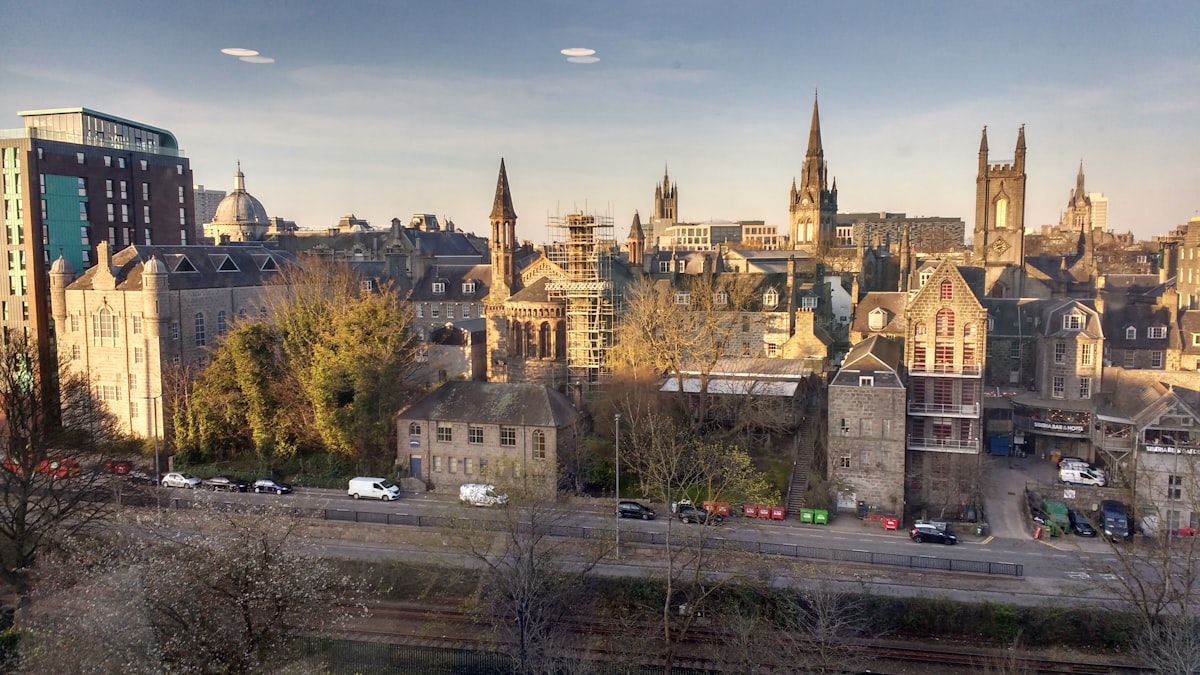
Understanding daylight requirements in Aberdeen City matters whenever you are planning a new home, a flatted development or an extension in the Granite City. Aberdeen City Council is the planning authority for the city, and the amount of natural light reaching both new and existing homes is a genuine consideration in how applications are assessed. In a compact, historic city built largely from silver-grey granite, with tightly grouped tenements and terraces, getting daylight and sunlight right at the design stage is particularly important.
This guide explains the planning framework that applies in Aberdeen, how daylight and sunlight are assessed in Scotland, and how a professional report prepared to recognised national methodology can support your application.
The planning framework in Aberdeen City
In Scotland, planning decisions are made in accordance with the statutory development plan. For Aberdeen, that plan now has two main parts:
- The Aberdeen Local Development Plan 2023, adopted by the council on 19 June 2023, which sets out the local policies for development across the city.
- National Planning Framework 4 (NPF4), adopted by the Scottish Ministers in February 2023. NPF4 is part of the statutory development plan for the whole of Scotland and carries full weight in decision-making alongside the Local Development Plan.
The Local Development Plan is further supported by the council's Aberdeen Planning Guidance and Supplementary Guidance 2023, which provides detail on how the plan's policies should be applied in practice.
Key policies relevant to daylight and sunlight
- Policy D1 (Quality Placemaking by Design) of the Aberdeen Local Development Plan 2023 requires all development to achieve high standards of design and to create successful, distinctive places informed by their context.
- Policy D2 (Amenity) is the policy most directly concerned with light and living conditions. It seeks to ensure appropriate levels of amenity, including designing in privacy, providing access to sitting-out areas, and ensuring that individual homes are designed to make the most of the opportunities the site offers for views and sunlight.
- NPF4 Policy 14 (Design, quality and place) applies a design-led approach based on the six qualities of successful places, including creating healthy, pleasant places to live.
- NPF4 Policy 16 (Quality homes) promotes high-quality, sustainable homes, reinforcing the expectation that new housing provides good internal amenity, including adequate daylight.
Together, these policies establish that good daylight and sunlight, for both proposed and neighbouring homes, is part of the high-quality, amenable living environment that Aberdeen's plan requires.
How daylight and sunlight is assessed in Aberdeen
Like most Scottish councils, Aberdeen City Council does not set its own numerical daylight or sunlight thresholds within the Local Development Plan. The plan and NPF4 set the policy expectation of good amenity, but they leave the technical measurement to established best practice.
That best-practice methodology is the Building Research Establishment guidance BRE BR 209 (2022), "Site layout planning for daylight and sunlight: a guide to good practice", together with the daylight standard BS EN 17037. These are not Scottish policy documents, but they are the recognised UK-wide benchmarks that planning officers and consultants use to demonstrate that a scheme provides acceptable daylight and sunlight. In Aberdeen, a BRE-based assessment is therefore the practical way to show that a proposal complies with the amenity and design expectations of Policy D2, Policy D1 and NPF4 Policies 14 and 16.
A typical assessment considers:
- Vertical Sky Component (VSC) and daylight distribution (the no-sky line) for existing neighbouring windows, to test any reduction in the light they currently receive.
- Annual Probable Sunlight Hours (APSH) for windows facing within 90 degrees of due south. At Aberdeen's northerly latitude, the sun sits relatively low in the sky, which makes careful consideration of sunlight and overshadowing especially valuable.
- Overshadowing of gardens, courtyards and shared amenity space, often expressed as the sunlit proportion on 21 March.
- Daylight and sunlight within the proposed homes, to confirm good internal living conditions.
Local factors that affect daylight in Aberdeen City
- The granite tenements and terraces. Much of Aberdeen's housing is in dense granite tenements and terraced streets, often four storeys or more. The close spacing of these buildings means infill, mansard or roof developments can readily affect a neighbour's light, so robust assessment is frequently needed.
- Union Street and the central conservation areas. The historic core, including the Union Street and Old Aberdeen conservation areas, combines tight urban grain with heritage sensitivity, where changes to massing must protect both daylight and the character of the streetscape.
- The harbour and city-centre regeneration. Aberdeen's harbour-side and central regeneration sites often involve higher-density and mixed-use schemes, where internal daylight and overshadowing of new courtyards must be demonstrated to meet Policy D2.
- Northerly latitude. Aberdeen lies further north than most major UK cities, so the low winter sun makes orientation, spacing and the protection of south-facing aspects particularly important to good sunlight outcomes.
When you are likely to need a daylight and sunlight report
An assessment is commonly advisable or requested where:
- A flatted or higher-density scheme needs to show good internal daylight for future residents.
- An infill, roof or backland proposal sits close to existing tenement or terrace windows.
- A development could overshadow a neighbouring garden, courtyard or shared amenity space.
- A neighbour has objected on grounds of loss of light, or an officer has raised an amenity concern under Policy D2.
Commissioning the assessment early, while the layout and massing can still be adjusted, generally gives the best result.
How Fortress Associates can help
Fortress Associates provides clear, robust our daylight and sunlight report service prepared to BRE BR 209 (2022) and BS EN 17037, written to support compliance with the Aberdeen Local Development Plan 2023 and the relevant NPF4 policies. We work nationwide, including across Aberdeen City, with a typical turnaround of 4 to 5 working days and no advance payment required. We also prepare Building Regulations drawings where a project needs them. To discuss a site in the city, please get in touch.
Sources & further reading
- Aberdeen City Council – Aberdeen Local Development Plan
- BRE BR 209 (2022) – Site layout planning for daylight and sunlight
- National Planning Framework 4 (NPF4)
- Related reading: Daylight Requirements in Aberdeenshire, covering the neighbouring rural authority.
- Contact Fortress Associates
Need help with a UK planning project?
Fixed-fee daylight reports and Building Regulations drawings — delivered in 4–5 working days. No advance payment.
Request a free quote