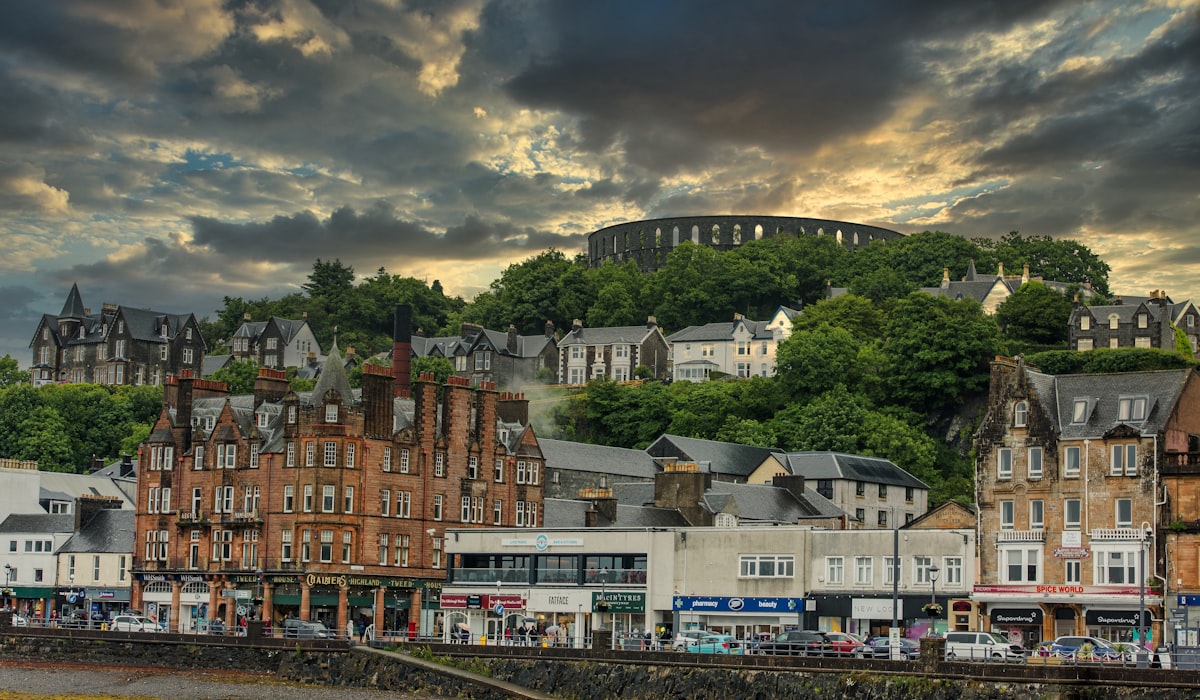
Understanding the daylight requirements in Argyll and Bute is important for anyone planning a house extension, an infill home or a larger residential development across this large and varied council area, from the bustling harbour town of Oban to the Victorian seafront at Helensburgh, the waterfront streets of Dunoon, and the many island and coastal communities in between. Argyll and Bute Council is the planning authority for the whole area and assesses householder and residential applications against its adopted development plan. This guide explains how daylight, sunlight, overshadowing and privacy are considered locally, which policies apply, and what an assessment to recognised best-practice standards involves.
Daylight requirements in Argyll and Bute: the planning framework
In Scotland the statutory development plan has two parts. The first is National Planning Framework 4 (NPF4), adopted by the Scottish Ministers in February 2023, which forms part of the development plan nationwide. The second, locally, is the Argyll and Bute Local Development Plan 2 (LDP2), adopted on 28 February 2024. LDP2 replaced the previous 2015 Local Development Plan and its associated supplementary guidance, and is now the up-to-date local plan against which proposals across the area are judged, read together with NPF4.
LDP2 is unusually clear about daylight and sunlight for a Scottish local plan. Its supporting text states directly:
"Access to sunlight and daylight is a vital part of a healthy environment. Sensitive design will provide sufficient daylight and sunlight to new housing whilst not obstructing light to existing homes nearby."
The plan goes further and sets out a local separation distance. To prevent a loss of privacy, 18 metres is generally considered the minimum acceptable distance between windows of habitable rooms, although the plan is careful to add that this may vary case by case to take account of other mitigating factors. This combination of a stated daylight principle and a numerical privacy distance is a genuinely local feature of the Argyll and Bute plan and a useful starting point for any scheme where buildings face one another.
The relevant LDP2 policies
Several adopted LDP2 policies bear on daylight, sunlight and amenity:
- Policy 05 - Design and Placemaking sets the overarching expectation that development is well designed and contributes positively to the quality of the place;
- Policy 08 - Sustainable Siting requires that "any development should be carefully sited to avoid overshadowing or overlooking of itself or other properties", and that buildings make the best use of solar gain through their position in the landscape;
- Policy 10 - Design: All Development sets the detailed design criteria that all proposals must meet, including respect for the character and amenity of the area; and
- Policy 14 - Bad Neighbour Development resists proposals that would have an unacceptable adverse impact on the amenity of neighbouring land uses.
Taken together, these policies treat daylight and sunlight as part of the wider amenity and design considerations the council weighs when determining an application. Where a proposal could affect a neighbour's light or privacy, the council can ask the applicant to provide evidence, including technical studies, to demonstrate that there would not be an unacceptable impact.
How NPF4 reinforces good amenity
NPF4 strengthens the design and amenity case. Policy 14 (Design, quality and place) asks development to be designed to a high quality that improves quality of life, drawing on the Six Qualities of Successful Places (healthy, pleasant, connected, distinctive, sustainable and adaptable). Good access to daylight and sunlight, and the avoidance of unacceptable overshadowing, are part of what makes a place healthy and pleasant. Policy 16 (Quality homes) seeks well-designed, sustainable homes and, for larger schemes, looks at how a proposal improves the residential amenity of the surrounding area. The local LDP2 policies and the national NPF4 policies are read together as the development plan.
How daylight and sunlight are actually measured
While LDP2 states a daylight principle and an 18-metre privacy distance, it does not set out its own technical method for calculating how much daylight or sunlight a window or garden actually receives. For that, the established methodology is the Building Research Establishment guidance, BRE BR 209: Site Layout Planning for Daylight and Sunlight - A Guide to Good Practice (2022 edition), read alongside the British Standard BS EN 17037 on daylight in buildings. These are the recognised UK best-practice documents and are routinely used by Scottish planning authorities, including Argyll and Bute, as the evidence base for assessing the daylight, sunlight and overshadowing impacts that LDP2 and NPF4 are concerned with. They turn the plan's qualitative language into objective, repeatable tests.
A BRE-based assessment considers both the daylight and sunlight enjoyed by neighbouring properties and the conditions future occupiers of the proposed development will receive. The principal tests include:
- Vertical Sky Component (VSC) - the amount of skylight reaching the centre of a neighbour's window, with a guideline value of 27%, or no worse than 0.8 times its former value;
- Daylight distribution (the no-sky line) - how well daylight reaches across the depth of a room;
- Annual Probable Sunlight Hours (APSH) - the sunlight reaching windows with a significant southerly aspect, assessed across the whole year and during the winter months;
- Overshadowing of gardens and amenity areas - using the sun-on-ground test on the equinox, relevant to the generous garden settings found across many Argyll and Bute communities.
A clear, BRE-compliant report gives an Argyll and Bute planning officer the objective evidence needed to judge a proposal against Policy 05, Policy 08 and Policy 10, alongside the plan's stated daylight principle and 18-metre privacy distance. It cannot promise consent, but it gives the council sound evidence on which to base a decision and helps applicants design out problems before they submit.
Common Argyll and Bute projects that benefit from an assessment
Daylight and sunlight questions arise most often where buildings sit close together or where new development changes the relationship between neighbours. Across Argyll and Bute these typically include:
- Rear and two-storey side extensions in the tightly built parts of Oban, Helensburgh, Dunoon and Rothesay, where homes share boundaries and the 18-metre privacy distance is in play;
- Infill and backland housing that introduces a new building behind or between existing homes;
- Schemes on sloping coastal sites, where topography and orientation strongly affect overshadowing and solar gain, exactly the issues Policy 08 asks applicants to address.
Presenting a BRE-based assessment up front helps an application run more smoothly and demonstrates to officers and neighbours that amenity impacts have been taken seriously.
How Fortress Associates can help
Fortress Associates prepares our daylight and sunlight report service to BRE BR 209 (2022) and BS EN 17037 for projects across Argyll and Bute, including Oban, Helensburgh, Dunoon, Rothesay and the surrounding coastal and island communities. We work nationwide with a typical 4 to 5 working day turnaround and ask for no advance payment. You can see the full range on our services page or contact us to discuss your site. Where a project also needs building warrant drawings under the Building (Scotland) Regulations and the Scottish technical handbooks, we can prepare those too. If your work spans more than one Scottish council, our sibling guide on the daylight requirements in Angus may also be useful.
Sources & further reading
Need help with a UK planning project?
Fixed-fee daylight reports and Building Regulations drawings — delivered in 4–5 working days. No advance payment.
Request a free quote