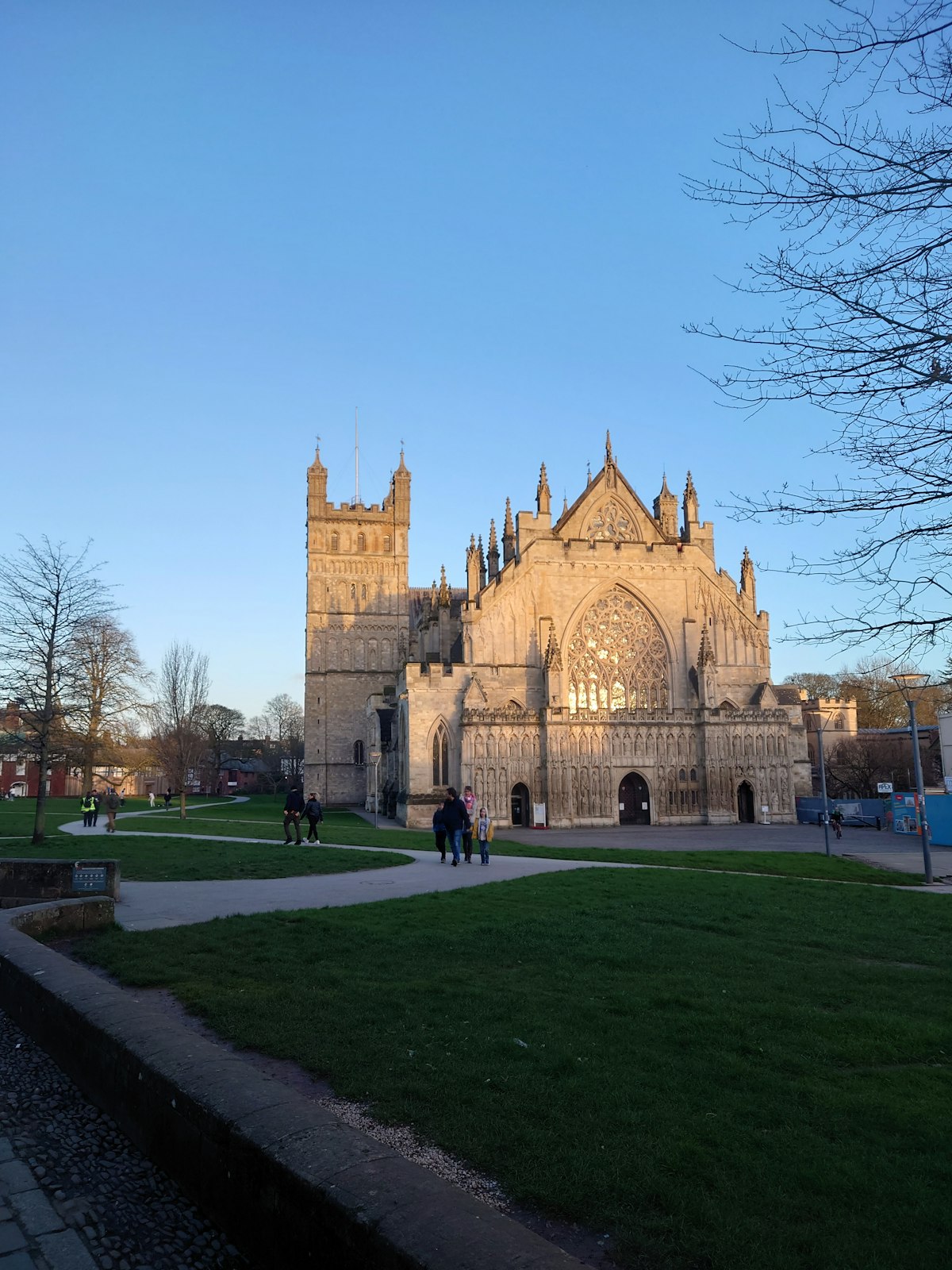
Few English cities pack as much history into so compact a footprint as Exeter. Roman walls, a medieval cathedral close, a Georgian core and a regenerating quayside all sit within a short walk of one another, and the University adds a steady demand for student and residential development. In that setting, the daylight requirements in Exeter are rarely a box-ticking exercise: they sit alongside heritage, townscape and the city’s well-documented sensitivity to building height. This guide explains which policies Exeter City Council — the local planning authority for the city in Devon — applies to daylight, sunlight and amenity, and how a technical assessment fits into a planning submission.
Who decides, and under which plan
Exeter City Council determines planning applications within the city boundary. Its development plan is currently made up of two adopted documents working together:
- The Exeter Local Plan First Review 1995–2011, a number of whose policies remain “saved” and continue to carry weight in decisions; and
- the Exeter Core Strategy, adopted on 21 February 2012, which sets the strategic framework for the city up to 2026.
A new Exeter Plan is well advanced and will eventually guide development to 2040; at the time of writing it has reached examination, with independent inspectors holding hearings during 2026. Until it is adopted, the saved First Review policies and the 2012 Core Strategy remain the documents your application is judged against. You can confirm the current position on the Exeter City Council planning service pages.
The policies behind the daylight requirements in Exeter
Exeter does not set out a single numerical daylight rule in its development plan. Instead, daylight, sunlight and overshadowing are dealt with as part of broader design and amenity policy, supported by detailed supplementary guidance:
- Policy DG1 — Objectives of Urban Design (Local Plan First Review). This sets out the urban design objectives every development is expected to meet, and is amplified by the Council’s householder guidance. Amenity, outlook and the relationship between buildings are core concerns.
- Policy DG7 (Local Plan First Review), which deals with safety and natural surveillance — the principle that homes and spaces should be overlooked for security while private spaces remain well defined and protected.
- Policy CP17 — Design and Local Distinctiveness (Core Strategy 2012), the strategic design policy requiring locally distinctive, high-quality and sustainable design that responds to its context.
The practical detail sits in two supplementary planning documents: the Residential Design Guide SPD and the Householder’s Guide to Extension Design SPD. These translate policy into workable expectations on layout, spacing and amenity. Notably, the Council’s guidance seeks a degree of privacy and outlook for occupiers — commonly achieved by a separation of around 22 metres between facing habitable-room windows, or by imaginative design that avoids windows directly facing one another. As the guidance itself stresses, privacy and amenity secured through good design are usually more effective than distance alone.
From policy words to numbers: BRE BR 209
When a neighbour or case officer raises “loss of light” or “overshadowing”, the recognised way to test it is the Building Research Establishment’s methodology. The standard reference is BRE BR 209 (2022), Site Layout Planning for Daylight and Sunlight. Exeter, like authorities across England, leans on BR 209 to judge whether a daylight or sunlight effect is acceptable, even though the council’s own policies are framed in the language of amenity rather than fixed figures.
The headline tests are summarised below.
| Test | What it measures | Typical benchmark |
|---|---|---|
| Vertical Sky Component (VSC) | Skylight reaching a neighbour’s window | ~27%, or no worse than a ~20% reduction from existing |
| Daylight distribution (No Sky Line) | How much of a room still sees sky | Retain a reasonable lit area |
| Annual Probable Sunlight Hours (APSH) | Sunlight to windows, mainly south-facing | BR 209 winter and annual thresholds |
| Overshadowing of amenity space | Sun reaching gardens and shared spaces | At least half the area sunlit on 21 March |
For the internal daylight of new homes — relevant to the city’s many apartment and student schemes — the European standard BS EN 17037 is increasingly used to demonstrate adequate daylight provision against target illuminance levels.
Why Exeter is its own case
Two local realities shape almost every daylight and sunlight assessment in the city.
Height and the cathedral skyline
Exeter is markedly sensitive to building height. Protecting key views of the Cathedral has, in the emerging plan-making, been associated with constraints such as a six-storey maximum in sensitive locations. Where buildings are kept lower to protect townscape and views, the daylight relationship between blocks — and the sunlight reaching streets and courtyards — comes under sharper scrutiny, because there is less room to trade height for separation.
A dense historic and quayside grain
Within the Roman and medieval core, plots are tight and existing windows sit close together, so even a modest extension or roof addition can affect a neighbour’s VSC. The regenerating quayside and riverside areas bring forward higher-density residential schemes where both the impact on existing homes and the internal daylight of the new units need careful, evidenced analysis.
Typical situations where an assessment is worthwhile
- Householder extensions in conservation areas and the historic core, where DG1 and the Householder’s Guide apply.
- Apartment, build-to-rent or student schemes near the University or quayside, engaging both BR 209 and BS EN 17037.
- Infill and backland development where the ~22-metre privacy expectation and overlooking are in question.
- Pre-application discussions, where an early BR 209 note can resolve an officer’s amenity concerns before validation.
If you are weighing how a different authority handles the same questions, our guide to the daylight requirements in North East Derbyshire offers a useful contrast with a non-metropolitan district.
How Fortress Associates can help
Fortress Associates prepares clear, defensible daylight and sunlight assessments to BRE BR 209 (2022) and BS EN 17037 for schemes throughout Exeter and across the UK. Whether you need a full report to accompany a planning application or a concise pre-application appraisal, our daylight and sunlight report service runs to a 4–5 working day turnaround with no advance payment required. See our services or contact us to discuss your site.
Sources & further reading
Need help with a UK planning project?
Fixed-fee daylight reports and Building Regulations drawings — delivered in 4–5 working days. No advance payment.
Request a free quote