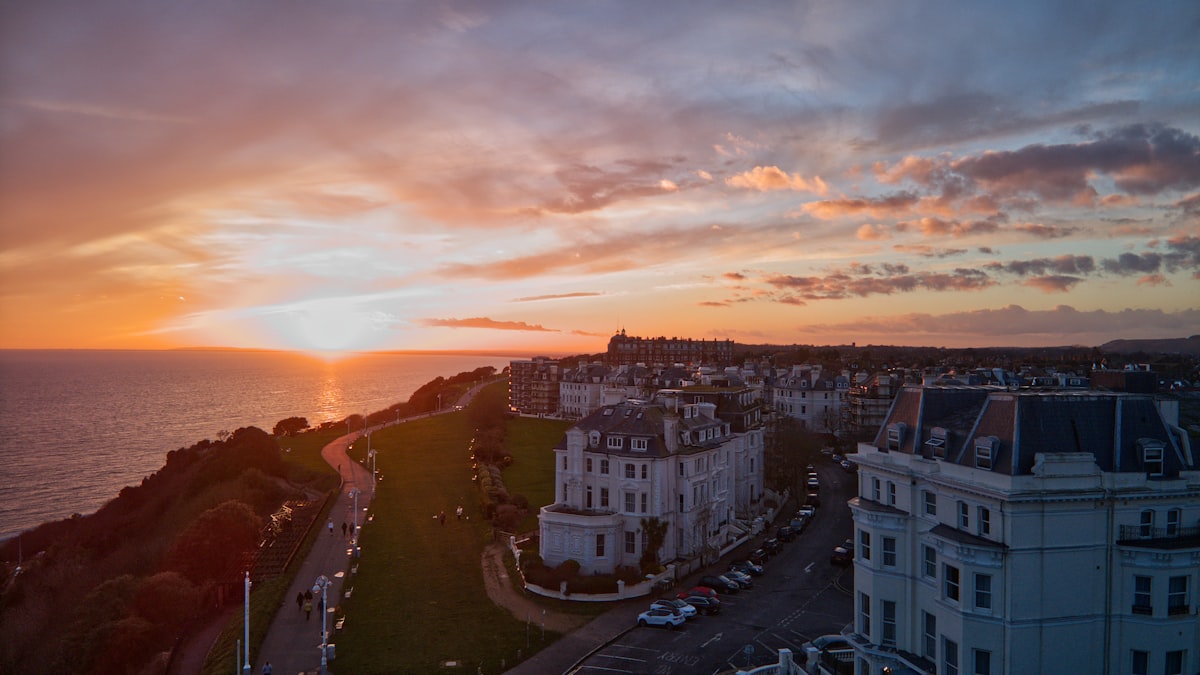
Understanding the daylight requirements in Folkestone and Hythe at the outset of a project can save considerable time and expense. The district stretches along the Kent coast and inland to the site of the major new garden settlement at Otterpool Park, and Folkestone & Hythe District Council assesses the impact of development on daylight, sunlight and neighbour amenity as a routine part of determining applications. This guide explains the policy framework, the technical standards involved, and the local factors that influence how light is judged across the district.
How daylight and sunlight are assessed in Folkestone and Hythe
Folkestone & Hythe District Council, formerly known as Shepway, is the local planning authority (LPA) for the district, which includes Folkestone, Hythe, the rural hinterland and the coast towards Romney Marsh. Although Kent County Council is the county authority, it is the District Council that applies the adopted development plan and decides the majority of applications. Officers consider both the daylight and sunlight available within a proposed development and the effect of that development on the daylight, sunlight, outlook and privacy of neighbouring occupiers.
The recognised technical benchmark is the Building Research Establishment guidance Site Layout Planning for Daylight and Sunlight: A Guide to Good Practice (BRE BR 209), updated in 2022, supported by BS EN 17037, the standard for daylight in buildings. These are not statutory rules, but they provide the methods used by planning authorities and the Planning Inspectorate to measure loss of light, including the Vertical Sky Component, the no-sky line and annual probable sunlight hours.
The adopted Local Plan and relevant policies
The adopted development plan for the district comprises the Places and Policies Local Plan (2020) and the Core Strategy Review, adopted on 30 March 2022. Several policies bear directly on daylight, sunlight and amenity:
- Policy HB1 (Quality Places Through Design) is the principal design policy, requiring development to achieve a high standard of design and to protect the amenity of existing and future occupiers.
- Policy HB2 (Cohesive Design) addresses how development relates to its surroundings, which feeds into questions of massing, overshadowing and outlook.
- Policy HB3 (Internal and External Space Standards) sets standards for living space, including external amenity space where sunlight and overshadowing are relevant.
- Policy HB4 (Alterations and extensions to existing buildings) deals specifically with extensions, requiring that they do not cause undue overshadowing of neighbouring property and allow adequate light to existing rooms.
Notably, the District Council's guidance is unusually specific on method for an English LPA. It applies a 25-degree test: where the whole of a proposed development falls below a line drawn at 25 degrees from the horizontal (measured from neighbouring windows), a substantial effect on daylight and sunlight is unlikely, but where development rises above that line, further assessment is required. For single-storey extensions, Policy HB4 expects the design to fall within a 45-degree angle taken from the centre of the nearest ground-floor habitable-room or kitchen window of a neighbouring property.
Validation and when a report is needed
A daylight and sunlight assessment is not required for every application. The supporting information should be proportionate to the scale and likely impact of the proposal. In practice, a dedicated report is most often expected where a scheme would breach the 25-degree line, sits close to neighbouring residential windows or gardens, or has prompted concern about overshadowing. Where the local thresholds are not triggered, amenity is still assessed through Policies HB1 to HB4, informed by BRE BR 209 (2022), BS EN 17037 and the National Planning Policy Framework.
Local factors that affect daylight in Folkestone and Hythe
Several characteristics of the district influence how light issues are handled:
- Otterpool Park garden settlement. The district is bringing forward a large new garden community at Otterpool Park near Westenhanger. New estate layouts at this scale raise questions about overshadowing of proposed homes and gardens as well as the relationship to existing neighbours, making daylight and sunlight a strategic design consideration.
- The coast and seafront regeneration. Folkestone's seafront and harbour area has seen substantial regeneration, including taller and higher-density residential schemes. In such locations, Vertical Sky Component and daylight-within-scheme assessments are frequently relevant, and the 25-degree test is a useful early screen.
- Established historic and coastal townscapes. Hythe's historic high street and the tightly built character of parts of Folkestone mean infill and extensions are scrutinised carefully for their effect on light reaching neighbouring properties.
A robust report identifies these context-specific risks early, allowing a design to be refined before submission rather than after a refusal.
How Fortress Associates can help
Fortress Associates prepares clear, defensible daylight and sunlight assessments to BRE BR 209 (2022), along with Building Regulations drawings, for projects throughout Folkestone and Hythe and across the UK. Our daylight and sunlight report service gives planning officers the evidence they need under Policies HB1 to HB4, including the district's 25-degree and 45-degree tests. We work to a 4 to 5 working day turnaround and require no advance payment. See our services or contact us to discuss a coastal or Otterpool Park scheme. If your project is in a neighbouring authority, read our guide to daylight requirements in Swale.
Sources & further reading
Need help with a UK planning project?
Fixed-fee daylight reports and Building Regulations drawings — delivered in 4–5 working days. No advance payment.
Request a free quote