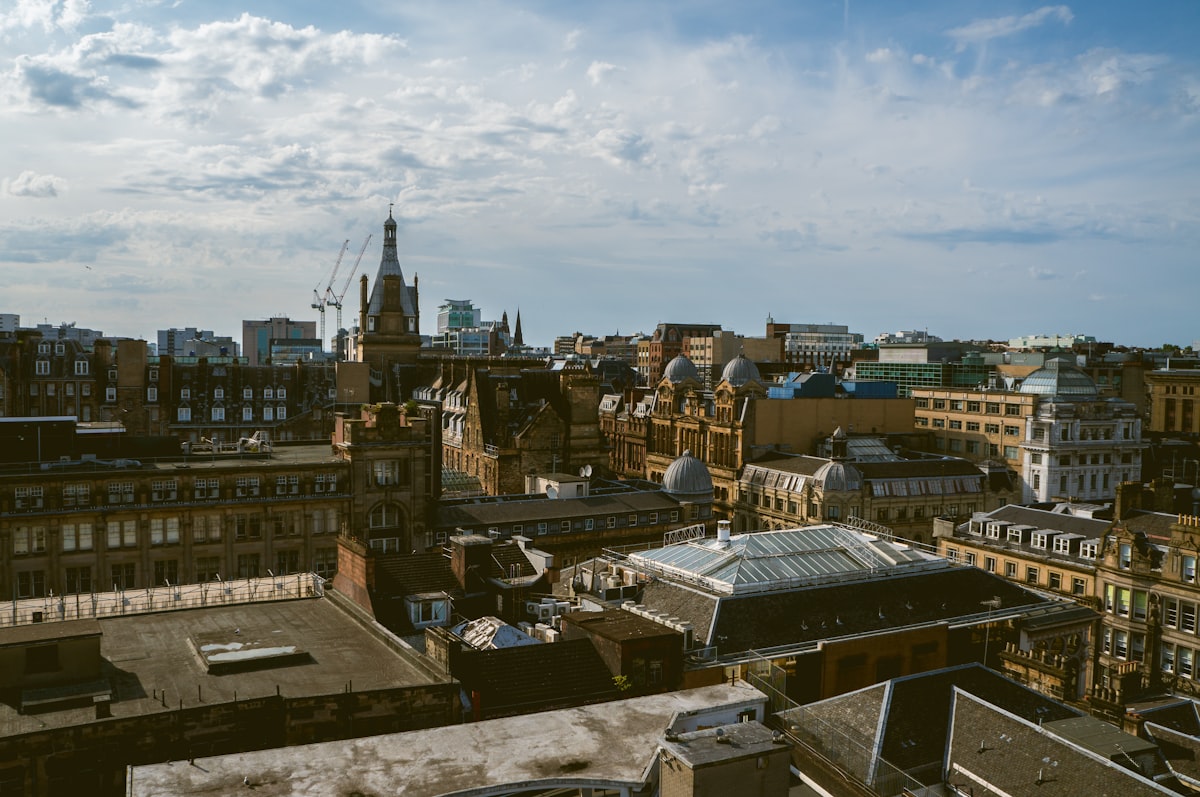
Understanding the daylight requirements in Glasgow City is essential for anyone proposing residential development in Scotland's largest city. Glasgow is one of the most daylight-sensitive planning environments in the country: dense Victorian and Edwardian tenement blocks, tight back-court arrangements, a growing cluster of tall buildings, and an active City Centre living agenda all combine to make daylight, sunlight and overlooking central concerns when a planning application is determined. This guide sets out how Glasgow City Council approaches these matters, which policies apply, and how a robust technical assessment supports a successful application.
The planning framework in Glasgow City
Planning decisions in the Glasgow City Council area are made against the adopted development plan, read alongside national policy. The two principal documents are:
- Glasgow City Development Plan (CDP), adopted in March 2017. The CDP is Glasgow's statutory local development plan and sets the strategic and policy context for development across the city. A second City Development Plan (CDP2) is being prepared, but the 2017 CDP remains the adopted plan at the time of writing.
- National Planning Framework 4 (NPF4), adopted on 13 February 2023. NPF4 forms part of the statutory development plan for the whole of Scotland and carries significant weight in every planning decision.
Both must be considered together. Where a proposal affects the daylight and sunlight of existing or proposed homes, the relevant policies in each document come into play.
Glasgow City Development Plan: Policy CDP1 and the Placemaking Principle
The cornerstone of the CDP is Policy CDP1 – The Placemaking Principle, which requires all development to be designed to create high-quality, successful and sustainable places. Amenity – including daylight, sunlight and privacy – sits squarely within this placemaking expectation. The policy is given practical effect through the Council's adopted statutory supplementary guidance.
The most directly relevant document is SG1: The Placemaking Principle (Parts 1 and 2), adopted in October 2018. Part 2 contains the detailed assessment criteria for physical design, covering design and materials, privacy and overlooking, and daylight and sunlight. Two points are particularly important for applicants:
- Glasgow's adopted tool for assessing daylight and sunlight is the Building Research Establishment guide Site Layout Planning for Daylight and Sunlight: a guide to good practice (BRE BR 209). The Council expects daylight and sunlight to be tested against this methodology.
- On privacy and overlooking, SG1 sets a clear benchmark: windows of habitable rooms that directly face each other (including dormers) should generally be at least 18 metres apart and at least 10 metres from the site boundary. These separation distances are a recurring feature of Glasgow decisions and are closely linked to daylight outcomes, because adequate separation also protects light to existing windows.
NPF4: Policies 14 and 16
At the national level, two NPF4 policies are most relevant to daylight and amenity:
- Policy 14 – Design, quality and place. This requires development to be consistent with the six qualities of successful places and not to be detrimental to the amenity of the surrounding area. Good daylight and sunlight are part of what makes a place "safe and pleasant" and well designed.
- Policy 16 – Quality homes. This seeks well-designed, energy-efficient homes and, for relevant proposals, asks how a development will improve the residential amenity of the surrounding area. Daylight and sunlight are a measurable component of residential amenity.
Because NPF4 is part of the statutory development plan, these policies apply in addition to – not instead of – the Glasgow CDP and its supplementary guidance.
Why Glasgow is a particularly demanding daylight context
Several features specific to Glasgow make daylight and sunlight assessment more challenging here than in many other authorities:
- Tenement density. Much of the inner city is characterised by four-storey sandstone tenements arranged around enclosed back courts. Infill and rooftop proposals in these blocks must be tested carefully for their effect on light to existing flats, which often rely on a single aspect.
- Tall buildings. Glasgow City Council has published a Tall Building Design Guide to manage the city's growing appetite for height and density. It requires daylight and sunlight assessment to be embedded early in the design process, alongside consideration of overshadowing of the public realm, seasonal variation, wind microclimate and cumulative effects across neighbouring developments. For taller schemes, a daylight and sunlight assessment is effectively a baseline expectation.
- City Centre living. Glasgow's strategy to increase the residential population of the city centre means more homes are being created on constrained, high-density sites and through the conversion of commercial buildings. Demonstrating acceptable internal daylight and protecting daylight to neighbours is central to making these proposals acceptable.
What the BRE guidance and BS EN 17037 actually measure
Glasgow relies on the BRE guidance, and a competent assessment will normally report against the following recognised measures:
Daylight to neighbouring properties
- Vertical Sky Component (VSC): the amount of skylight reaching the centre of an existing window. The BRE guide flags a noticeable reduction where VSC falls below 27% or drops to less than 0.8 times its former value.
- No Sky Line / Daylight Distribution: assesses how much of a room still receives direct skylight after a development is built.
Sunlight
- Annual Probable Sunlight Hours (APSH): sunlight is checked for windows facing within 90 degrees of due south, with attention to both annual and winter sunlight.
Internal daylight for new homes
For daylight inside proposed dwellings, assessments increasingly reference BS EN 17037 (Daylight in Buildings), the European standard now used alongside BRE BR 209. The 2022 edition of BR 209 was updated to align with BS EN 17037, and together they provide target illuminance and daylight provision levels for habitable rooms – a key consideration for the deep-plan and single-aspect units common in Glasgow city-centre conversions.
In Glasgow, a daylight and sunlight report is rarely just a technical formality. On constrained tenement and city-centre sites it is often the evidence that determines whether a scheme is judged acceptable in amenity terms.
Practical tips for proposals in Glasgow
- Assess early. The Tall Building Design Guide and SG1 both expect daylight to inform massing and layout from the outset, not to be checked at the end.
- Respect the 18 metre / 10 metre separation. Where window-to-window distances fall short, expect to justify the departure clearly, including its daylight and overlooking implications.
- Test cumulative effects. On city-centre and tall-building sites, the combined impact of consented neighbouring schemes can matter as much as your own proposal.
- Document existing conditions. Accurate survey of existing tenement windows and back courts is essential for a defensible VSC and daylight-distribution analysis.
How Fortress Associates can help
Fortress Associates provides our daylight and sunlight report service to BRE BR 209 (2022) and BS EN 17037, prepared specifically for the Glasgow planning context. We assess impact on neighbouring tenements and the internal daylight of proposed homes, and set the findings against Glasgow's CDP, SG1 and the Tall Building Design Guide as well as NPF4. We work UK-wide with a typical turnaround of 4 to 5 working days and no advance payment. If you also need supporting drawings, we prepare building warrant and Building (Scotland) Regulations drawings. See our services or get in touch via our contact page.
Sources & further reading
- Glasgow City Council – City Development Plan and Supplementary Guidance
- BRE – BR 209 Site Layout Planning for Daylight and Sunlight (2022 edition)
- Scottish Government – National Planning Framework 4 (NPF4)
- Fortress Associates – our services
- Daylight Requirements in Inverclyde (related guidance for a neighbouring Scottish authority)
Need help with a UK planning project?
Fixed-fee daylight reports and Building Regulations drawings — delivered in 4–5 working days. No advance payment.
Request a free quote