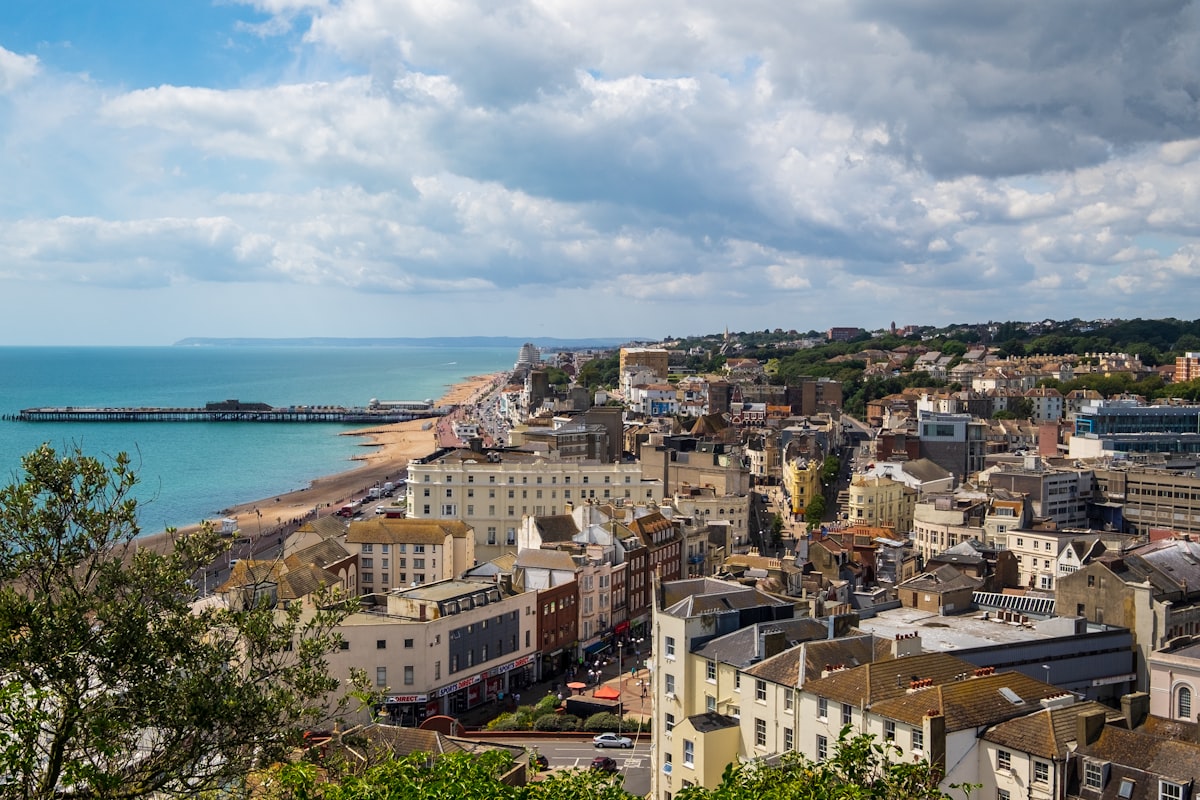
Understanding the daylight requirements in Hastings is essential before designing an extension, a flat conversion or a new infill home in this densely built East Sussex seaside town. Hastings Borough Council is the local planning authority (LPA) for the borough — the shire district, not East Sussex County Council, decides householder and residential planning applications and sets the relevant amenity and design policies. This guide explains how daylight and sunlight are assessed against the council's adopted policies and the recognised technical standards.
Daylight requirements in Hastings and the adopted Local Plan
The statutory development plan is made up of two adopted documents that together form the Hastings Local Plan:
- the Hastings Planning Strategy, adopted on 19 February 2014; and
- the Development Management Plan (DMP), adopted by Full Council on 23 September 2015.
Daylight and sunlight sit within the borough's design and amenity policies in the Development Management Plan. The two key policies are:
- Policy DM1 – Design Principles, which requires all proposals to reach a good standard of design, responding to local character, topography and street pattern, and to consider the layout and orientation of buildings — including taking account of the effects of solar gain.
- Policy DM3 – General Amenity, which is the central policy for daylight. Criterion 1 requires that the scale, form, height, mass and density of buildings “reduces or avoids any adverse impact on the amenity (privacy, over shadowing, loss of daylight) of neighbouring properties.”
In other words, Hastings names loss of daylight and overshadowing expressly within its amenity policy, alongside privacy. What the Local Plan does not do is set numerical daylight or sunlight thresholds, so the council relies on established technical guidance to apply DM3 in practice.
The role of BRE BR 209 (2022), BS EN 17037 and the NPPF
The recognised methodology for measuring daylight and sunlight impacts is the Building Research Establishment's BRE BR 209 (2022), Site Layout Planning for Daylight and Sunlight: A Guide to Good Practice, supported by the British Standard BS EN 17037 for daylight within new dwellings. The National Planning Policy Framework underpins the local approach by supporting good living conditions and resisting development that would harm the amenity of existing or future occupiers. Policy DM1 itself refers to performance against “nationally recognised best practice guidance”, which is the route by which BR 209 is brought to bear on Hastings applications.
Householder guidance and the validation checklist
Hastings does not have a dedicated daylight or amenity Supplementary Planning Document. Instead, the council publishes practical householder advice and a guide, “Planning Permission – a guide for Householders”. Its extensions guidance is refreshingly specific and reflects local experience of tightly packed plots:
“It is important to take account of windows on neighbouring properties to make sure any extension does not result in unreasonable loss of daylight or sunlight.”
The same guidance discourages two-storey extensions close to boundaries because of potential loss of light, suggests rear extensions of roughly three metres depth as a rule of thumb to limit neighbour impact, and warns that differences in ground level can make an extension appear far larger from an adjoining property. The council's Validation Checklist (updated in 2024) sets out the documents required to register an application; a standalone daylight and sunlight assessment is not a blanket requirement, but where loss of light or overshadowing is a credible concern a BRE-based report is the standard way to evidence compliance with Policy DM3.
Why Hastings sites need careful daylight assessment
Hastings has a built form that makes daylight and sunlight unusually sensitive:
- The Old Town, between the East and West Hills, is a tightly woven historic quarter of narrow plots, twittens and closely spaced buildings — including the distinctive net huts on the Stade — where even modest additions can affect a neighbour's light.
- Much of the wider borough is built in dense Victorian and Edwardian terraces on steeply sloping ground, so small changes in height or projection can have a disproportionate overshadowing effect on rooms and gardens below.
- The borough's complex topography — expressly recognised in Policy DM1 — means accurate site sections and levels are often decisive in demonstrating that a scheme respects neighbouring amenity.
What a BRE BR 209 (2022) assessment covers
A robust daylight and sunlight report for a Hastings scheme typically addresses:
- Daylight to neighbours — the Vertical Sky Component (VSC), commonly assessed against the 27% guideline and the 0.8-times-former-value test, plus the no-sky-line check for daylight distribution within rooms.
- Sunlight to neighbours — the Annual Probable Sunlight Hours (APSH) test for windows facing within 90 degrees of due south.
- Overshadowing of gardens and amenity space — the guideline that at least half of an amenity area should receive at least two hours of sunlight on 21 March.
- Daylight within the proposed dwellings, assessed against BS EN 17037 targets.
Presenting these results clearly helps a Hastings case officer apply Policy DM3 with confidence, while remembering that the BRE figures are guidance to be applied flexibly in an established urban context rather than fixed pass/fail limits.
How Fortress Associates can help
Fortress Associates provides our daylight and sunlight report service to BRE BR 209 (2022) and BS EN 17037, written to address Policy DM3 and the Hastings Local Plan. We also prepare Building Regulations drawings to the Approved Documents (Parts A–S). We work nationwide with a 4–5 working day turnaround and ask for no advance payment. For an Old Town or terraced-street project, please contact us. You may also find our guide to daylight requirements in Rother useful if your project is nearby in Bexhill or Rye.
Sources & further reading
Need help with a UK planning project?
Fixed-fee daylight reports and Building Regulations drawings — delivered in 4–5 working days. No advance payment.
Request a free quote