Daylight requirements in Kirklees are governed by the residential amenity and design policies of the adopted Kirklees Local Plan, with the technical detail supplied by BRE BR 209 (2022), Site Layout Planning for Daylight and Sunlight, BS EN 17037 and national planning policy. Kirklees Council does not publish its own daylight calculation figures, so the BRE methodology is the recognised benchmark used to judge whether a scheme protects light to neighbours and provides acceptable conditions for future occupiers.
If you are extending a home in Huddersfield, building out in Dewsbury or Batley, or developing in one of the Holme or Colne valley villages, a clear daylight and sunlight report is frequently the most direct way to satisfy the council on amenity. This article explains the Kirklees policy position, the supplementary guidance householders should know about, and the local characteristics that shape how light issues arise here.
The adopted Kirklees Local Plan and Policy LP24
Kirklees has a relatively recent, single-authority development plan. The Kirklees Local Plan was adopted on 27 February 2019 and is made up of two parts: the Strategy and Policies document and the Allocations and Designations document. This is the statutory plan against which planning applications across the borough are decided.
The central policy for daylight and overshadowing is:
- Policy LP24 (Design) — requires development to provide a high standard of amenity for both future and neighbouring occupiers. It expects appropriate distances between buildings, the prevention of overlooking and loss of privacy, and the use of layout and form to maintain good living conditions. Loss of daylight and sunlight to neighbouring habitable rooms and gardens falls squarely within this amenity test.
A second policy is also relevant where light spill or shadowing is part of the picture:
- Policy LP52 (Protection and Improvement of Environmental Quality) — addresses pollution including light and shadow effects, requiring proposals with the potential to cause such impacts to be supported by evidence that they have been evaluated and mitigated.
Because LP24 sets the amenity standard in qualitative terms rather than fixed numbers, the BRE BR 209 (2022) tests are what officers and appeal inspectors use to put a figure on the impact. A report measured against those targets gives the council an objective basis for its decision.
Kirklees supplementary planning guidance
Kirklees has gone further than many authorities in providing detailed, locally adopted design guidance. Two Supplementary Planning Documents, both adopted on 29 June 2021, are particularly important:
- House Extensions and Alterations SPD — written for householders, agents and architects, this sets out the standard of design the council expects for extensions and alterations, including the treatment of windows, dormers and rooflights, separation distances and impacts on neighbours' light and outlook.
- Housebuilders Design Guide SPD — aimed at residential developers, covering the quality, layout and environmental performance of new housing schemes.
Crucially, Kirklees applies a "comply or justify" approach to this guidance. Proposals that follow the SPD are likely to progress more smoothly, while a scheme that departs from it must provide full justification. Where an extension or new building could materially reduce a neighbour's daylight or sunlight, that justification is most convincingly made with a numerical assessment to BRE BR 209 (2022), demonstrating either compliance with the standards or that any shortfall is reasonable in context.
Validation and what to submit
Kirklees publishes validation requirements for planning applications and asks applicants to submit a completed checklist with their submission. While a daylight and sunlight report is not demanded for every minor scheme, it is often expected, or specifically requested, where a proposal sits close to neighbouring windows, increases massing, or is likely to fail the council's design tests. Providing the evidence up front reduces the risk of delay, a request for further information, or refusal on amenity grounds.
The daylight and sunlight tests explained
BRE BR 209 (2022) sets out the principal measures used to assess impact on neighbours:
- Vertical Sky Component (VSC) — the skylight reaching the centre of a neighbour's window; 27% is a commonly cited good level, and a fall to below 0.8 times the previous value is treated as potentially noticeable.
- No Sky Line (NSL) — the proportion of a room that can still see the sky, indicating how daylight is distributed across the space.
- Annual Probable Sunlight Hours (APSH) — the sunlight a window receives over the year, most relevant for windows facing within 90 degrees of due south.
For the new dwellings themselves, BS EN 17037 and its UK National Annex set target daylight levels inside the rooms. Our guide to VSC, NSL and APSH daylight metrics breaks these down, and if you are new to the process our overview of what a daylight report is explains how the analysis is set out for a UK planning submission.
Local factors that shape daylight schemes in Kirklees
Kirklees is a large and varied borough, and several local characteristics influence how light and overshadowing questions play out:
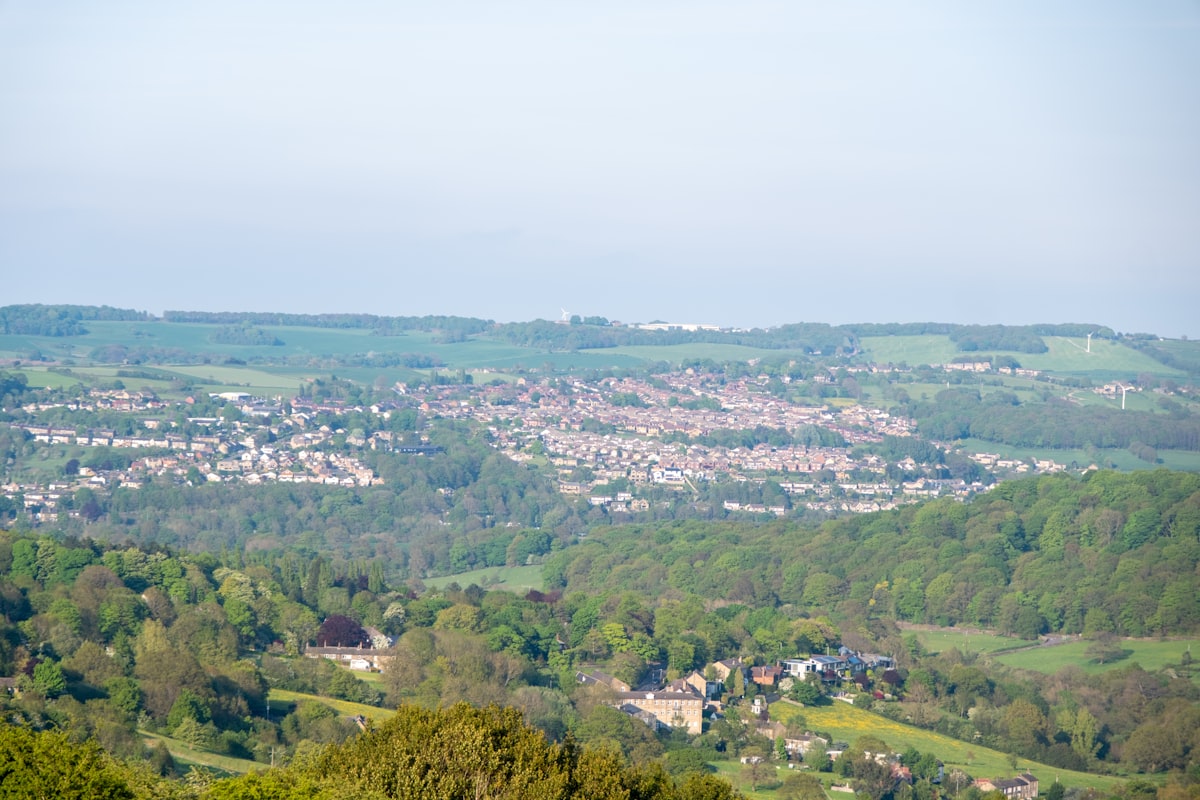
- Dense Pennine stone terraces. Settlements such as Holmfirth and the Colne and Holme valley villages are known for closely knit, stone-built terraced houses stacked on steep hillsides and linked by narrow lanes. The tight spacing and changes in level mean rear extensions and infill regularly raise daylight, sunlight and overlooking issues.
- Extensive conservation areas. The borough contains around 60 conservation areas, including the Huddersfield town-centre conservation area with its nationally significant Victorian architecture and many listed buildings. Development in or near these areas must balance light and amenity with the protection of historic character.
- Textile-heritage townscape. Former weavers' cottages, mills and mill-worker housing across places like Linthwaite, Batley and Dewsbury create distinctive, often high-density contexts where new development and conversions need careful daylight study.
- Town-centre regeneration. Renewal in Huddersfield and Dewsbury town centres can involve denser and taller schemes, where overshadowing of surrounding homes is a genuine consideration.
Across all of these, the absence of a council-specific daylight figure means the BRE targets are effectively the standard the LP24 amenity test is measured against.
How Fortress Associates can help
Fortress Associates produces daylight and sunlight assessments for sites throughout Kirklees, from single rear and loft extensions in the valley villages to larger housing schemes in Huddersfield and Dewsbury. Each report is prepared to BRE BR 209 (2022), BS EN 17037 and the NPPF, and references the adopted Kirklees Local Plan, Policy LP24 and the House Extensions and Alterations SPD so the council can see precisely how your scheme measures up against the "comply or justify" expectation. Learn more about our daylight and sunlight report service and the wider services we provide.
We operate nationwide with a 4 to 5 working day turnaround and require no advance payment, so you can obtain robust, locally relevant evidence without holding up your application. Our reports are designed to improve your approval prospects by evidencing compliance, or by setting out proportionate mitigation where the figures are tight. To talk through a Kirklees project, please contact us or call 07448 539 682.
Sources & further reading
Need help with a UK planning project?
Fixed-fee daylight reports and Building Regulations drawings — delivered in 4–5 working days. No advance payment.
Request a free quote