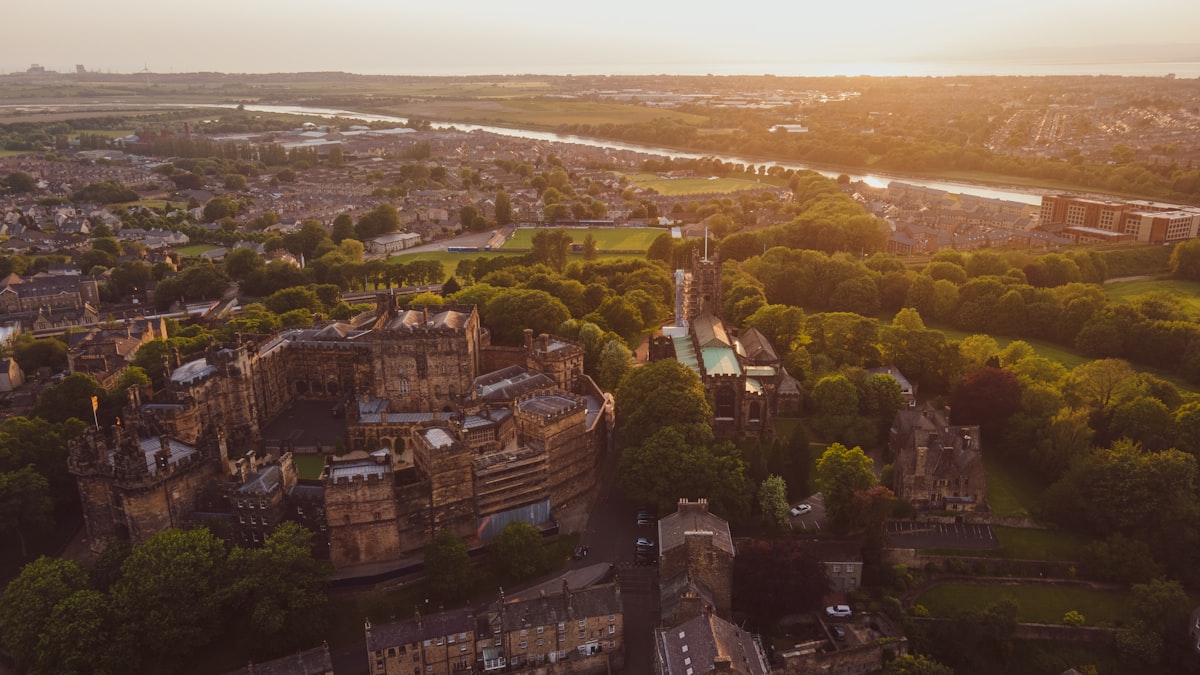
Understanding the daylight requirements in Lancaster is essential for anyone proposing a house extension, an infill dwelling or a larger residential scheme anywhere in the district, from the historic streets around Lancaster Castle to the seafront at Morecambe and the surrounding Lune Valley villages. Lancaster City Council is the local planning authority (LPA) for the area; Lancashire County Council is the upper-tier authority but is not the body that determines most householder and residential planning applications. This guide explains how daylight and sunlight are considered locally, which adopted policies apply, and what an assessment to recognised standards involves.
Daylight requirements in Lancaster: the policy framework
The development plan for the area is the Local Plan for Lancaster District, which following the council's climate emergency review was re-adopted on 22 January 2025. It is made up of two principal documents: the Part One: Strategic Policies and Land Allocations DPD and the Part Two: Development Management DPD (both adopted 22 January 2025), alongside the Morecambe Area Action Plan and the Arnside and Silverdale AONB DPD.
For daylight, sunlight and residential amenity the most directly relevant policy is Policy DM29: Key Design Principles in the Development Management DPD. Among its general design requirements, the policy expects new development to:
"Ensure there is no significant detrimental impact to amenity in relation to overshadowing, visual amenity, privacy, overlooking, massing and pollution."
Overshadowing and overlooking sit at the heart of how the council weighs the impact of a proposal on neighbouring living conditions. The same policy also asks development to optimise solar gain through site layout and building orientation, so daylight and sunlight are treated both as an amenity issue for neighbours and as an energy-efficiency consideration for new homes.
Privacy, separation and overshadowing
The Development Management DPD goes further than many local plans in setting out numerical guidance. Under the heading "Ensuring Privacy" at paragraph 9.3, it states that new dwellings should be "as private and free from overlooking and overshadowing as possible" and sets out the following principles:
- There should normally be at least 21 metres between dwellings where windows of habitable rooms face each other, and 12 metres where a habitable room faces onto a side wall with no such window;
- For every half-metre change in levels between properties, a further 1 metre of separation should be provided;
- The main windows of habitable rooms should not be overshadowed by boundary walls, fences or two-storey gable walls; and
- Excessively high screening should be avoided.
The plan is careful to add (paragraph 9.4) that these minimum distances will not always be acceptable and may need to be increased or reduced depending on site topography, levels or density. The garden-space guidance at paragraph 9.5 is also relevant to sunlight, noting that small north-facing gardens should normally be avoided and that at least 50 square metres of usable private garden space should be provided for new houses, not directly overlooked by neighbours.
Design guidance and validation in Lancaster
Lancaster does not publish a standalone daylight and sunlight Supplementary Planning Document. Instead, design expectations are explained through the council's Planning Advisory Notes (PANs) on residential design and householder development, which expand on the key design principles in Policy DM29, and through the council's Validation Guide, which sets out when a Design and Access Statement is required. Where a proposal raises a realistic prospect of harm to a neighbour's daylight or sunlight, the practical expectation is that this is demonstrated by assessment against the recognised national methodology.
That methodology is the Building Research Establishment guidance, BRE BR 209: Site Layout Planning for Daylight and Sunlight - A Guide to Good Practice (2022 edition), read alongside the British Standard BS EN 17037 on daylight in buildings. The National Planning Policy Framework (NPPF) supports making efficient use of land while securing well-designed places and a good standard of amenity, and these national documents are applied through the locally adopted policies above. In short, BR 209 provides the technical tests (vertical sky component, the daylight distribution / no-sky line, the annual probable sunlight hours test for sunlight, and overshadowing of amenity areas) that allow the qualitative amenity language of Policy DM29 to be measured objectively.
What a daylight and sunlight assessment involves
A BRE-based assessment typically considers two questions: the daylight and sunlight enjoyed by neighbouring properties, and the daylight and sunlight that future occupiers of the proposed development will receive. The principal tests include:
- Vertical Sky Component (VSC) - the amount of skylight reaching the centre of a neighbour's window, with a guideline value of 27%, or no worse than 0.8 times its former value;
- Daylight distribution (no-sky line) - how daylight is spread across a room;
- Annual Probable Sunlight Hours (APSH) - the sunlight reaching windows with a significant southerly aspect, assessed across the whole year and the winter months;
- Overshadowing of gardens and amenity areas - using the sun-on-ground test on the equinox, relevant given Lancaster's guidance on usable private garden space.
A clear, BRE-compliant report helps a Lancaster planning officer judge a proposal against Policy DM29 and the privacy principles at paragraph 9.3. It is particularly valuable for terraced and back-to-back layouts in central Lancaster, taller infill near the seafront in Morecambe, and rear or two-storey side extensions where overshadowing of a neighbour's habitable-room windows is a common concern. A robust assessment cannot promise consent, but it gives officers the evidence to reach a sound decision and helps applicants design out problems before submission.
How Fortress Associates can help
Fortress Associates prepares our daylight and sunlight report service to BRE BR 209 (2022) and BS EN 17037 for projects across Lancaster, Morecambe, Carnforth and the wider district. We work nationwide with a typical 4 to 5 working day turnaround and ask for no advance payment. You can see the full range on our services page or contact us to discuss your site. We also produce Building Regulations drawings where these are needed alongside a planning submission.
Sources & further reading
Need help with a UK planning project?
Fixed-fee daylight reports and Building Regulations drawings — delivered in 4–5 working days. No advance payment.
Request a free quote