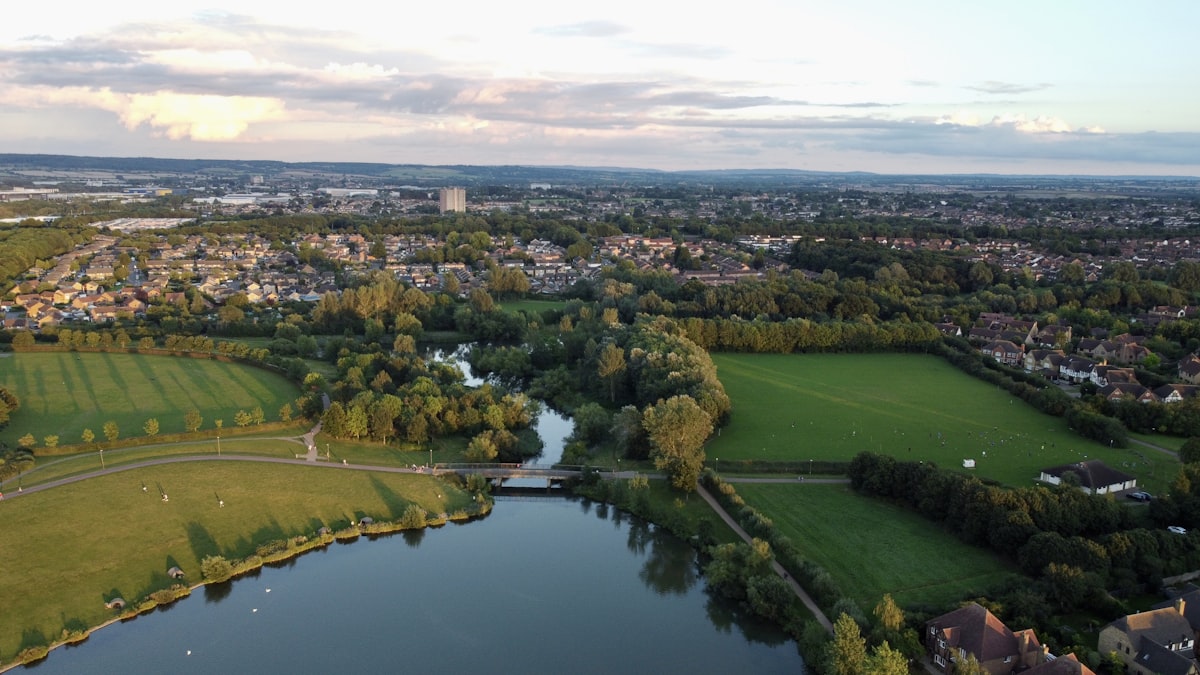
Understanding the daylight requirements in Milton Keynes is essential for anyone planning a house extension, an infill dwelling or a larger residential scheme across the borough. Milton Keynes City Council is a unitary authority, which means it acts as the Local Planning Authority for the whole area – from Central Milton Keynes (CMK) and the grid-square estates to the surrounding villages and the expansion areas on the edge of the new city. This article explains how the Council assesses the impact of development on daylight and sunlight, which local planning policies apply, and where nationally recognised technical standards fit in.
Daylight requirements in Milton Keynes: the policy framework
The statutory development plan for the area is Plan:MK 2016–2031, which was adopted by the Council on 20 March 2019. Plan:MK replaced the former Core Strategy (2013) and the saved policies of the Milton Keynes Local Plan (2005), and it now forms the primary basis against which planning applications are determined. A new local plan, the MK City Plan 2050, is being prepared and reached Regulation 18 consultation stage in 2024, but until that plan is adopted, Plan:MK remains the document that matters for decisions today.
Daylight and sunlight are dealt with primarily as a matter of residential amenity. The most directly relevant policies in Plan:MK are:
- Policy D5 (Amenity and Street Scene) – the key amenity policy. It seeks to ensure that all development proposals create and protect a good standard of amenity for existing and future occupiers, and for neighbouring buildings and their occupiers. In practice the Council uses Policy D5 to assess loss of daylight and sunlight, overshadowing, overlooking and loss of privacy.
- Policy D1 (Designing a High Quality Place) – the overarching design policy requiring well-designed development that responds to its context.
- Policy D2 (Creating a Positive Character) and Policy D3 (Design of Buildings) – which together govern layout, massing, scale and the relationship between buildings, all of which influence how much daylight and sunlight reaches neighbouring windows and gardens.
Officer reports for householder and residential applications in Milton Keynes routinely cite Policies D1 to D3 and D5 together when weighing up whether a proposal would cause an unacceptable loss of daylight or sunlight to adjoining dwellings.
Is there a specific daylight and sunlight standard for Milton Keynes?
Milton Keynes does not currently publish a numerical daylight and sunlight standard of its own. The Council's New Residential Development Design Guide Supplementary Planning Document (adopted 2012) provides detailed guidance on character, layout, streets, parking and the detailed appearance of buildings, and the relationships it sets out between buildings indirectly affect daylight and sunlight. However, it does not set out the kind of numerical daylight tests (such as Vertical Sky Component or the No Sky Line) that planners use to measure impact.
Because there is no bespoke local metric, the recognised national technical benchmarks apply through Policy D5. In practice this means:
- The Building Research Establishment guidance BR 209, Site Layout Planning for Daylight and Sunlight: A Guide to Good Practice (2022 edition) – the standard methodology used to assess loss of light to existing neighbours and the availability of light within new dwellings.
- BS EN 17037 Daylight in Buildings – the British and European standard for daylight provision within habitable rooms.
- The National Planning Policy Framework (NPPF), which expects new development to provide a good standard of amenity and, since recent revisions, encourages a flexible approach to optimising the use of land while securing well-designed places.
The Council's Planning Application Validation Requirements can require a daylight, sunlight and overshadowing assessment to be submitted in support of an application where the scale or location of a proposal makes light impacts a material consideration. For larger or more sensitive schemes, providing a BRE-based assessment up front is often the difference between a smooth validation and a request for further information.
Local factors that affect daylight in Milton Keynes
Milton Keynes has a planning character that is genuinely different from most British towns, and that character has a direct bearing on daylight and sunlight:
- The grid-square layout. The city is organised around a grid of main roads (the “V” and “H” routes) enclosing residential grid squares. Many estates were designed at relatively low density with generous spacing, mature landscaping and consistent building lines, so proposals that introduce taller or more closely spaced forms can stand out and need careful daylight justification.
- Central Milton Keynes (CMK). The city centre is a higher-density, taller-building environment where new residential and mixed-use blocks are being delivered. Here daylight and sunlight assessment between facing buildings, and the daylight reaching habitable rooms within new flats, becomes especially important under Policy D5.
- Expansion and regeneration areas. New neighbourhoods on the edge of the city and renewal sites within it bring fresh layout decisions where overshadowing of gardens and amenity space, and the orientation of new homes for sunlight, are recurring considerations.
What this means for your project
Whether you are extending a home on a grid-square estate or bringing forward apartments in CMK, the Council will expect you to demonstrate that neighbouring properties retain acceptable daylight and sunlight and that new homes themselves are well lit. A clear, BRE-based assessment helps planning officers reach a positive recommendation and gives neighbours confidence that impacts have been properly considered. It is sensible to commission this analysis early, before the design is fixed, so that any adjustments to height, depth or position can be made while they are still easy.
How Fortress Associates can help
Fortress Associates provides our daylight and sunlight report service to homeowners, architects and developers across Milton Keynes and the rest of the UK. Our reports are prepared to BRE BR 209 (2022) and BS EN 17037 and are written to support your application under Plan:MK Policy D5. We typically turn assessments around in 4–5 working days, and we ask for no advance payment. We also prepare Building Regulations drawings to the Approved Documents (Parts A–S). To discuss your scheme, please get in touch.
Related reading
If your project is elsewhere in the country, you may find our guide to daylight requirements in North East Lincolnshire a useful comparison of how a different unitary authority approaches the same issues.
Sources & further reading
Need help with a UK planning project?
Fixed-fee daylight reports and Building Regulations drawings — delivered in 4–5 working days. No advance payment.
Request a free quote