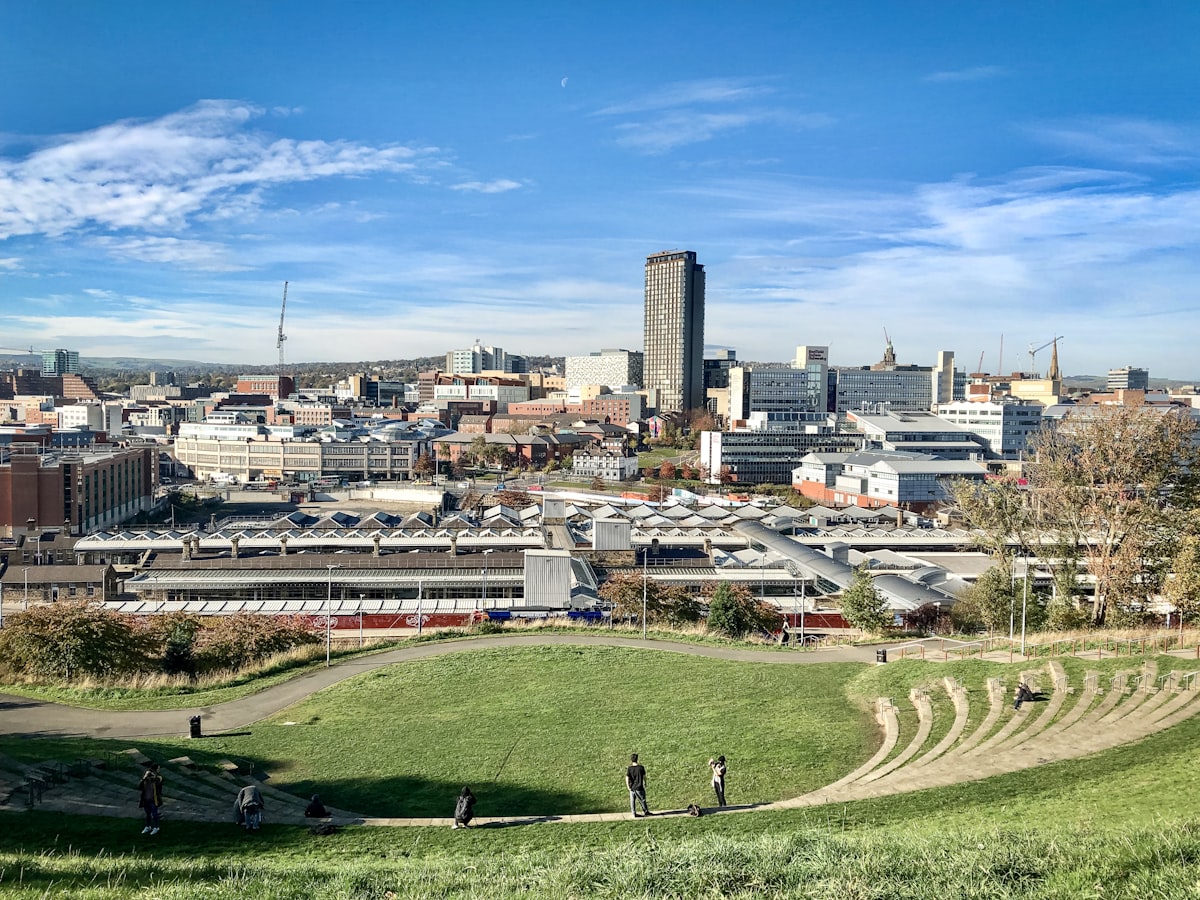
Few cities pose as many light-and-shadow questions for designers as Sheffield. Built across seven hills and threaded by river valleys, the city combines steep topography, dense Victorian neighbourhoods and a wave of city-centre regeneration. Understanding the daylight requirements in Sheffield — how the council expects daylight, sunlight and overshadowing to be handled — is therefore essential for almost any residential or mixed-use scheme. This article sets out the planning framework Sheffield City Council uses, the guidance that applies, and the local conditions that make assessments here distinctive.
The planning framework: which plan applies
Sheffield City Council is the unitary local planning authority for the city. As of June 2026 the adopted development plan is made up of two documents:
- the Sheffield Development Framework Core Strategy (adopted 4 March 2009); and
- ‘saved’ policies of the Sheffield Unitary Development Plan (UDP) (adopted 1998), which remain in force where they have not been superseded.
A new plan — the Sheffield Plan, covering the period to 2039 — is at an advanced stage. Following independent examination, the council consulted on Main Modifications between 2 March and 5 May 2026, with adoption expected to be considered by Full Council in summer 2026. Until the Sheffield Plan is formally adopted, the Core Strategy and saved UDP policies remain the decision-making baseline, while the emerging plan carries increasing weight as a material consideration.
Key policies for amenity, daylight and design
Sheffield does not express daylight in a standalone numerical policy. Instead the protection of light and amenity flows from its design and housing policies:
- Core Strategy Policy CS74 (Design Principles) sets out the high-quality design expectations for new development, including residential schemes, and confirms that the Building for Life standard is used to assess major housing proposals.
- Saved UDP Policy H14 (Conditions on Development in Housing Areas) requires that new development does not cause nuisance or harm to the living conditions of nearby residents and is consistent with the residential character of the area.
- Saved UDP Policy H15 (Design of New Housing Developments) seeks well-designed housing with adequate privacy, daylight and useable amenity space.
- Saved UDP Policy BE5 (Building Design and Siting) addresses the form, siting and relationship of new buildings to their surroundings.
Read together, these policies require that a proposal protects daylight, sunlight and privacy for neighbours while providing acceptable conditions for its own occupiers.
Local design guidance
Sheffield supports these policies with practical guidance, including its “Designing House Extensions” advice for householder proposals and the South Yorkshire Residential Design Guide, a best-practice guide used across the four South Yorkshire authorities and linked to the Building for Life assessment model. These documents help applicants understand expectations on separation, overshadowing and overlooking before a scheme is finalised.
How daylight is measured: the BRE methodology
Where a quantified daylight and sunlight assessment is needed, Sheffield — like authorities across England — relies on the nationally recognised methodology rather than its own figures:
- BRE BR 209, Site Layout Planning for Daylight and Sunlight: A Guide to Good Practice (2022 edition), which provides the Vertical Sky Component, daylight distribution, Annual Probable Sunlight Hours and overshadowing tests used to assess impact on existing neighbours;
- BS EN 17037 (Daylight in Buildings), used to demonstrate daylight provision for the future occupiers of new dwellings; and
- the National Planning Policy Framework (NPPF), which calls for good standards of amenity and the efficient use of land, encouraging a flexible application of daylight guidance where it would otherwise prevent sensible densities.
What makes Sheffield distinctive
Several local characteristics shape how daylight and sunlight questions arise in the city:
Topography and the seven hills
Sheffield’s dramatic gradients mean that buildings frequently sit above or below their neighbours. Differences in ground level change how overshadowing and loss of light play out, and a flat “rule of thumb” assessment can be misleading. Sloping sites often need careful, site-specific modelling.
Conservation areas and historic character
The city has around 38 conservation areas, including the City Centre Conservation Area — home to Paradise Square, Sheffield’s only Georgian square — and leafy suburban areas such as Ranmoor. In these areas, extensions and infill must respect both neighbour amenity and historic character, and permitted development rights may be restricted.
City-centre regeneration and density
Major projects such as Heart of the City and the wider regeneration around Pinstone Street and Charter Square are delivering taller, denser development in the urban core. On constrained city-centre plots, demonstrating acceptable daylight to neighbours and adequate light within new homes is often a decisive issue.
Student and shared housing
With two large universities, Sheffield has significant student and shared-housing markets, particularly in areas like Broomhill and Crookes. Conversions and purpose-built schemes regularly raise questions about internal daylight standards and the effect on neighbouring family housing.
When a daylight and sunlight report is advisable
- Two-storey or larger extensions close to neighbouring habitable-room windows.
- Backland, infill or sloping-site development where levels complicate light assessment.
- Taller city-centre or edge-of-centre residential and mixed-use schemes.
- Proposals where neighbours, officers or a pre-application response have raised loss of light.
- Schemes creating multiple new dwellings whose internal daylight must be shown under BS EN 17037.
Providing a clear, BRE-based assessment at submission helps officers, focuses any negotiation on genuine issues and reduces the risk of refusal on amenity grounds. Always check the council’s current validation requirements for your specific application type.
How Fortress Associates can help
Fortress Associates provides our daylight and sunlight report service to BRE BR 209 (2022) and BS EN 17037, set within Sheffield’s adopted policy framework. We assess the impact on neighbouring properties and the daylight available within new homes, accounting for the city’s challenging topography. We operate UK-wide, turn most reports around in 4–5 working days, and ask for no advance payment. See our services or contact us to talk through your site. Our reports are designed to improve your approval prospects by addressing the relevant tests clearly and transparently.
Related reading
For a comparison with another major metropolitan borough, see our guide to daylight requirements in Sandwell.
Sources & further reading
Need help with a UK planning project?
Fixed-fee daylight reports and Building Regulations drawings — delivered in 4–5 working days. No advance payment.
Request a free quote