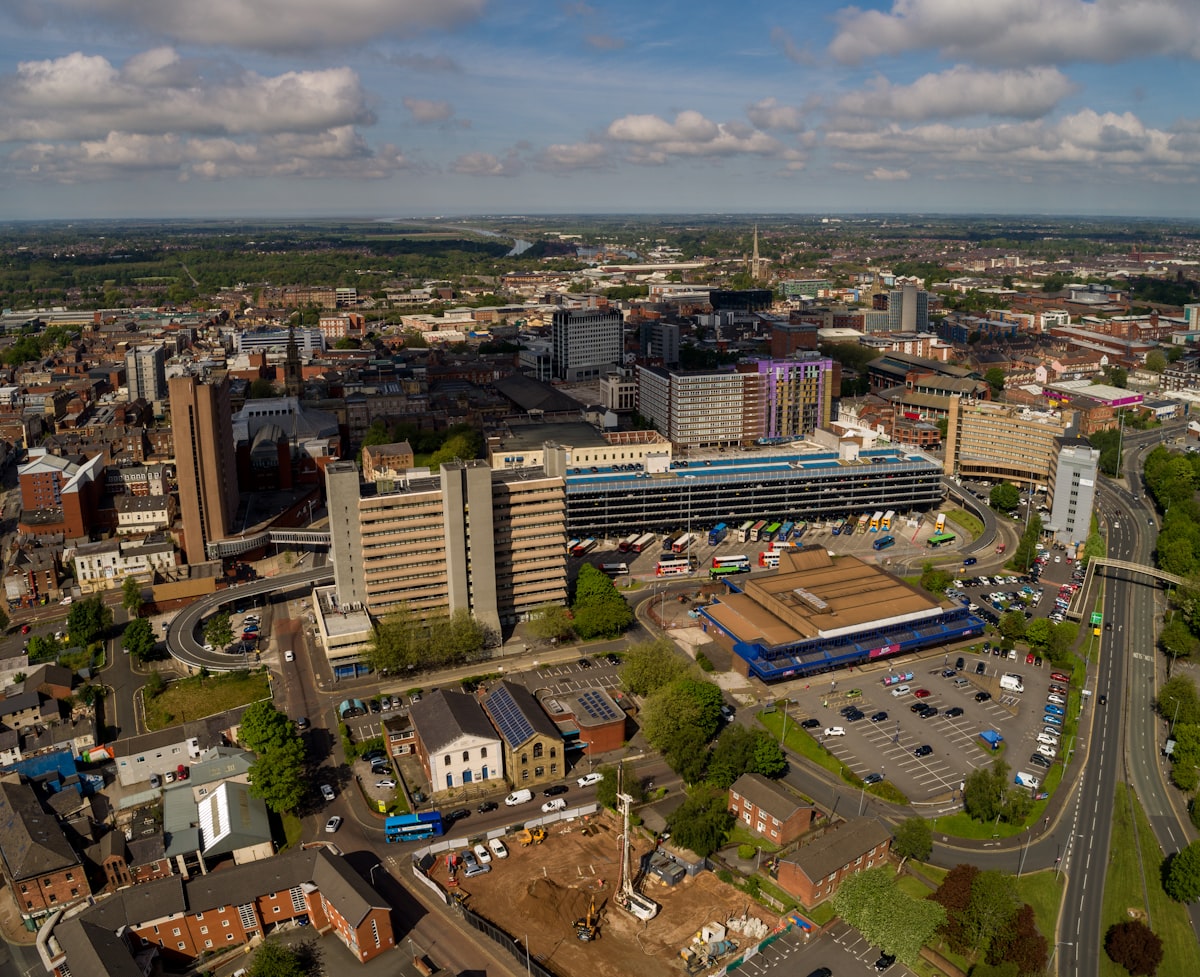
If you are designing a house extension, an infill plot or a larger residential scheme in Preston, understanding the daylight requirements in Preston early will save you time, money and the risk of refusal. Preston City Council is the local planning authority (LPA) that determines these applications — not Lancashire County Council — so it is the city's adopted development plan and supplementary guidance that decide how the daylight, sunlight and amenity impact of a proposal is judged, from the Harris quarter and the Avenham terraces to Fulwood, Ingol and the rural fringes.
This guide explains the local policy structure, the council's own design guidance, the specific numerical rules it uses for householder schemes, and how the recognised national daylight standards apply.
Daylight requirements in Preston: the development plan
Preston's development plan has two main parts that work together:
- The Central Lancashire Core Strategy, adopted in July 2012 and prepared jointly by Preston City Council, Chorley Council and South Ribble Council. It sets the strategic direction for the period 2010 to 2026.
- The Preston Local Plan 2012–2026 (Site Allocations and Development Management Policies), adopted on 2 July 2015, which provides the detailed development management policies for most of the city.
The principal design and amenity policy is Core Strategy Policy 17 – Design of New Buildings. Policy 17 requires new development to be of a high design standard and to protect the amenity of neighbouring and future occupiers, which is the basis on which loss of daylight, sunlight, privacy and any overbearing effect is assessed. This is reinforced at the local plan level through the council's design policy for new development (carried forward as Policy EN8 – Design of New Development), and underpinned by the National Planning Policy Framework (NPPF), which requires a high standard of amenity for existing and future users.
Preston's daylight and sunlight guidance: the Residential Extensions and Alterations SPD
Unlike some neighbouring boroughs that share a joint extensions guide, Preston has its own dedicated Residential Extensions and Alterations Supplementary Planning Document (final version for Cabinet, April 2013). It is a material consideration for householder applications and gives the most precise picture of how the council handles daylight and sunlight in practice. The SPD expressly implements Core Strategy Policy 17 and the local plan design policy.
The SPD's general design principles state that extensions and alterations should be designed so that they do not cause an unacceptable loss of sunlight or daylight to neighbours, do not cause an unacceptable loss of privacy, and are not dominant or overbearing. It then sets out specific, measurable rules. The most important for daylight is the 45-degree rule in policy SP3 (single storey rear extensions):
Single storey extensions must not protrude more than 3 metres from the rear wall or beyond a 45-degree line drawn in the horizontal plane from a point on the boundary with an attached house, 3 metres from the rear wall. Where the length of the 45-degree line would exceed 12 metres before reaching any part of a proposed extension, the 45-degree rule need not apply.
On privacy and outlook, the SPD requires minimum separation distances between houses, particularly between windows lighting primary habitable rooms — defined as living rooms, dining rooms, studies, kitchens with dining areas, bedrooms and breakfast areas (kitchens without dining areas, bathrooms, storerooms, circulation spaces and garages are excluded). Where two habitable room windows directly face each other, the separation requirement applies so that residents retain a satisfactory degree of privacy and daylight. The SPD also notes that balconies are unlikely to be acceptable because of overlooking, and that where obscure glazing is offered as mitigation it must be to level 5 obscurity.
How the national daylight standards apply in Preston
The SPD's rules are a robust first filter for straightforward householder cases. For more complex proposals — flats, backland sites, taller buildings or any scheme where neighbour daylight is genuinely in question — the city council expects a technical daylight and sunlight assessment. Because Preston's policies set the amenity principle rather than the calculation method, the recognised national benchmarks apply through Policy 17 and the NPPF:
- BRE BR 209 (2022), Site Layout Planning for Daylight and Sunlight: A Guide to Good Practice — the standard methodology covering Vertical Sky Component (VSC), the No Sky Line / daylight distribution, Annual Probable Sunlight Hours (APSH) and garden and amenity-space overshadowing.
- BS EN 17037 (Daylight in Buildings) — used to assess the internal daylight provision of new dwellings.
- The NPPF — which also asks decision-makers to apply daylight guidance flexibly where rigid application would inhibit the efficient use of land in areas of high housing demand, such as Preston city centre.
Local factors that affect daylight schemes in Preston
Preston's varied urban fabric shapes how daylight and sunlight issues arise:
- The historic city centre and the Harris quarter. The Grade I-listed Harris building, the Guild Hall and the surrounding conservation areas create a context where tall and dense development is scrutinised closely for overshadowing of streets, public space and neighbouring residential windows. As a former Guild town, Preston's city-centre regeneration sites routinely require BR 209 assessments.
- Avenham and the inner terraces. The closely packed Victorian terraces around Avenham and Frenchwood produce tight back-to-back relationships where rear extensions and dormers frequently engage the SPD's 45-degree rule and separation distances. These are exactly the situations where a measured daylight assessment can resolve a dispute about overshadowing.
How Fortress Associates can help
Fortress Associates provides our daylight and sunlight report service to BRE BR 209 (2022) and BS EN 17037, prepared specifically for the Central Lancashire Core Strategy, the Preston Local Plan and the city council's Residential Extensions and Alterations SPD. We assess VSC, daylight distribution, APSH and overshadowing for neighbours, and internal daylight for new homes, in the format Preston City Council expects. We also produce Building Regulations drawings to support your scheme. We work UK-wide, typically deliver reports in 4 to 5 working days, and ask for no advance payment. To discuss a project in the city centre, Fulwood, Ingol, Avenham or anywhere in Preston, please get in touch.
You may also find our companion guides useful: daylight requirements in Fylde and daylight requirements in Wyre.
Sources & further reading
Need help with a UK planning project?
Fixed-fee daylight reports and Building Regulations drawings — delivered in 4–5 working days. No advance payment.
Request a free quote