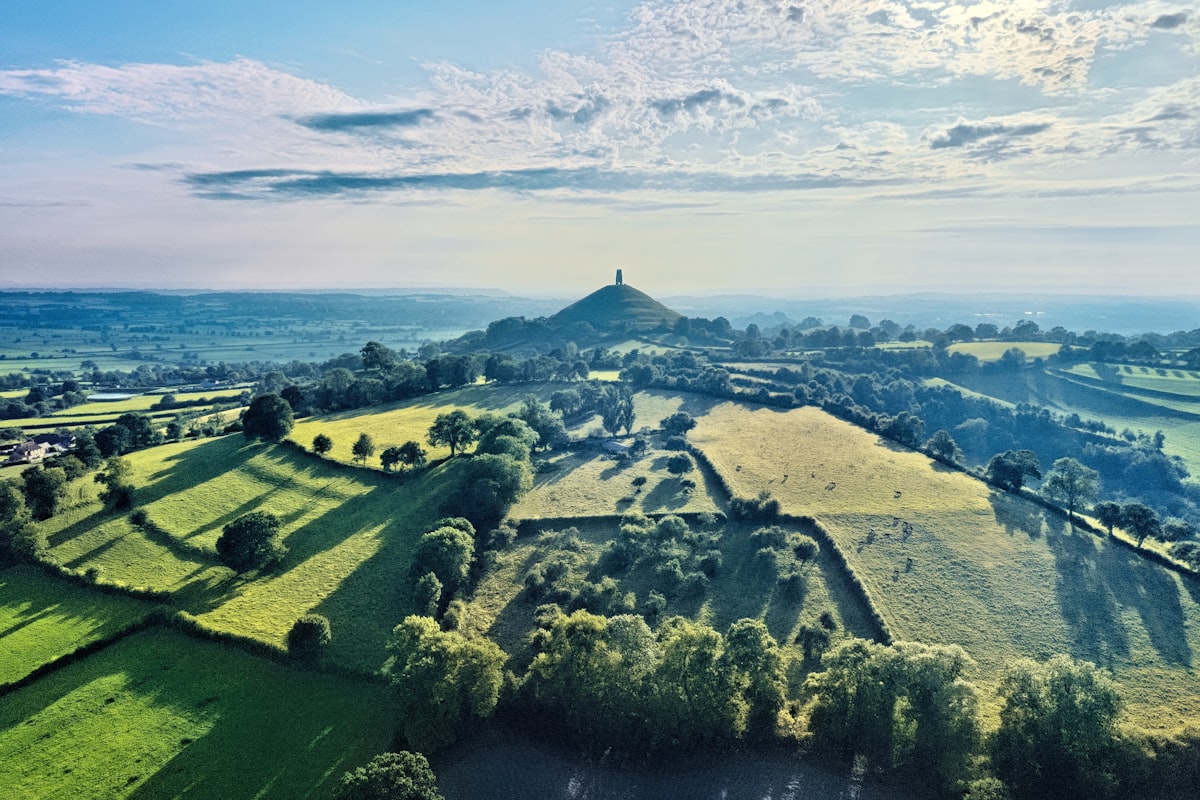
Daylight requirements in Somerset are unusual among English authorities, because the planning policy you must comply with depends on where in the county your site sits. Somerset Council became a single unitary authority on 1 April 2023, merging the former county council with the four district councils of Mendip, Sedgemoor, Somerset West and Taunton, and South Somerset. It is now the Local Planning Authority for the whole county — from Glastonbury and Wells beneath the Tor, across the Somerset Levels, to Taunton and Yeovil — but it has not yet replaced the inherited local plans. This guide explains how daylight and sunlight are assessed across Somerset, which adopted policies apply where, and how a professional report supports an application.
The planning policy framework for daylight in Somerset
Although Somerset Council is one authority, there is not yet one local plan. Until the new countywide plan is adopted, planning applications are still decided against the adopted local plan for the relevant former district area. In practice this means four separate development plans remain in force:
- Mendip District Local Plan Part I 2006–2029 (adopted 15 December 2014) and Local Plan Part II (adopted December 2021) — covering Glastonbury, Wells, Street, Shepton Mallet and Frome.
- South Somerset Local Plan 2006–2028 (adopted March 2015) — covering Yeovil, Chard, Crewkerne, Ilminster and surrounding rural areas.
- The adopted local plan for the former Sedgemoor district — covering Bridgwater, Burnham-on-Sea and the coastal Levels.
- The adopted local plan for the former Somerset West and Taunton area — covering Taunton, Wellington, Minehead and West Somerset.
Somerset Council is preparing the Somerset Local Plan 2045, a single plan intended to replace all four inherited plans. That work began after the unitary council was formed and is expected to take several years to reach adoption, so for now applicants must identify which legacy plan governs their site and apply its policies.
Amenity and design policies that engage daylight
The legacy plans do not set numerical daylight targets, but they all contain amenity and design policies under which daylight, sunlight, overshadowing, privacy and outlook are assessed. Two clear examples are:
- Mendip Local Plan Policy DP7 (Design and Amenity of New Development), which requires development to protect the amenity of users of neighbouring buildings and land and to provide a satisfactory environment for current and future occupants. Mendip also adopted a Design and Amenity of New Development Supplementary Planning Document to help applicants show how a proposal meets DP7.
- South Somerset Local Plan Policy EQ2 (General Development), which requires development to respect local context and to protect the amenity of existing residents, including by avoiding unacceptable overlooking and loss of amenity.
The Sedgemoor and Somerset West and Taunton plans contain equivalent design and amenity policies for their areas. In every case, the policy sets the principle — protect neighbouring amenity — and the detailed technical test is carried out using national guidance.
How national daylight guidance applies
Because none of the Somerset legacy plans contain their own daylight figures, the recognised methodology is applied through the local plan and the National Planning Policy Framework. The standard reference is the Building Research Establishment's Site Layout Planning for Daylight and Sunlight: A Guide to Good Practice, BRE BR 209 (third edition, 2022), supported by BS EN 17037 on daylight in buildings. These provide the numerical tests planning officers expect: vertical sky component (VSC) and daylight distribution (no sky line) for daylight; annual probable sunlight hours (APSH) for sunlight; and overshadowing assessment for gardens and amenity spaces.
Daylight requirements in Somerset: what this means in practice
Somerset is predominantly a county of market towns, villages and open countryside rather than high-rise development, so the daylight question most often arises in two situations.
Householder extensions and infill
Most daylight and sunlight issues in Somerset concern rear and two-storey extensions, and small infill plots, in places such as Wells, Glastonbury, Yeovil, Taunton and Bridgwater. Where an extension may overshadow a neighbour's window or garden, an officer will weigh it against the relevant amenity policy — DP7 in the Mendip area or EQ2 in South Somerset, for example. A BRE BR 209 assessment showing VSC and APSH results gives the case officer the objective evidence needed to judge whether the effect is acceptable.
Heritage and townscape sensitivity
Somerset contains many conservation areas and listed buildings — the cathedral city of Wells, the historic core of Glastonbury, and Georgian Taunton among them — where design and amenity are scrutinised closely. The low-lying Somerset Levels also create open, light-sensitive settings. In these contexts, demonstrating that a scheme respects both the character of the area and the daylight and sunlight of neighbouring properties strengthens an application considerably.
What a daylight and sunlight report should contain
For a Somerset application, a thorough assessment will normally include:
- Identification of the correct legacy local plan and amenity policy for the site's location.
- VSC and daylight distribution (no sky line) results for affected neighbouring windows, tested against BRE BR 209 (2022).
- APSH sunlight results and overshadowing analysis for gardens and amenity areas.
- For new dwellings, an assessment of the daylight and sunlight the proposal itself would receive, with reference to BS EN 17037.
- A clear conclusion on compliance, with a reasoned explanation of any guideline that is not met.
In a county still operating four inherited local plans, getting the policy basis right is as important as the technical numbers — a good report does both.
How Fortress Associates can help
Fortress Associates provides our daylight and sunlight report service for sites across Somerset and the rest of the UK. We assess daylight, sunlight and overshadowing to BRE BR 209 (2022) and BS EN 17037, and set the results against the correct legacy local plan policy for your site. Our standard turnaround is 4–5 working days and we ask for no advance payment. We also prepare Building Regulations drawings to Approved Documents A–S. To discuss a project, get in touch with our team.
Sources & further reading
Need help with a UK planning project?
Fixed-fee daylight reports and Building Regulations drawings — delivered in 4–5 working days. No advance payment.
Request a free quote